Publications
|
For a complete list of Jane's publications, please see her Google Scholar profile. Her highest cited paper has over 11,000 citations (Vitousek et. al. 1997). She has 10 papers with over 1,000 citations each, and 21 papers with over 500 citations each. Some of her recent papers are below.
|
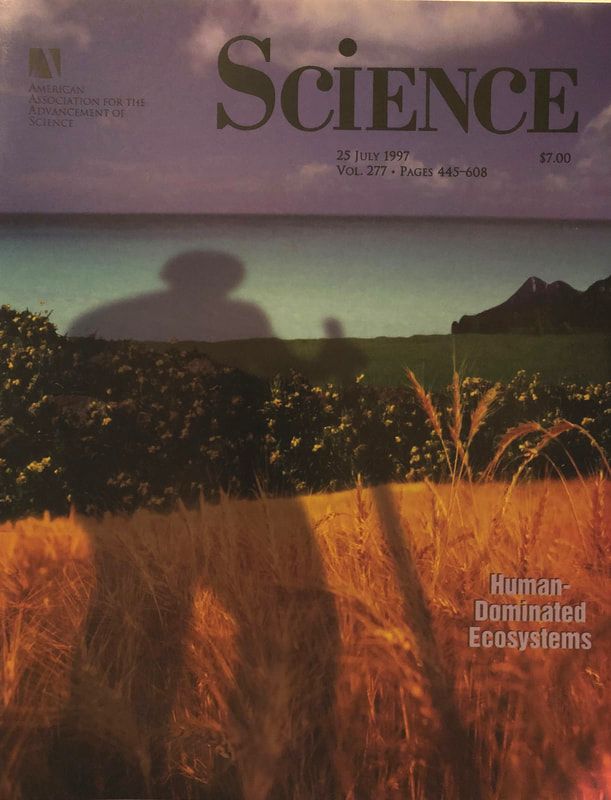
Vitousek et al. 1997 has over 11,000 citations.
|
|
Some recent publications:
- Grorud-Colvert, et. al. 2021. The MPA Guide: a framework to achieve global goals for the ocean. Science. https://www.science.org/doi/10.1126/science.abf0861 and see: https://mpa-guide.protectedplanet.net/ - Sala, E., et. al. 2021. Protecting the global ocean for biodiversity, food, and climate. Nature. https://doi.org/10.1038/s41586-021-03371-z - Folke, C., et. al. 2021. Our Future in the Anthropocene Biosphere. Ambio. https://doi.org/10.1007/s13280-021-01544-8 |
|
- Liu, J., et. al. 2021. Coupled Human and Natural Systems: the Evolution and Applications of an Integrated Framework. Ambio. https://doi.org/10.1007/s13280-020-01488-5
- Lubchenco, J., Haugan, P., and M. Pangestu. 2020. 5 Priorities for a Sustainable Ocean Economy. Nature 588: 30-32. https://doi.org/10.1038/d41586-020-03303-3
- Stuchtey, Martin R., et al. 2020. Ocean Solutions that Benefit People, Nature and the Economy. 148p. Report. Washington, DC: World Resources Institute. https://oceanpanel.org/ocean-action/files/full-report-ocean-solutions-eng.pdf
- Costello, C., L. et al. 2020. The Future of Food from the Sea. Nature 588: 95-100 https://doi.org/10.1038/s41586-020-2616-y
- Steffen, W., et al. 2020. The emergence and evolution of Earth System Science. Nature Reviews Earth & Environment Jan 2020, 1: 54-63. Doi: https://doi.org/10.1038/s43017-019-0005-6 https://www.nature.com/articles/s43017-019-0005-6
- Lubchenco, J. and C. Rapley. 2020. “Our Moment of Truth: The Social Contract Realized?” Environmental Research Letters 15:110201.
https://dx.doi.org/10.1088/1748-9326/abba9c
- Hough-Guldberg, O., E. Northrop, and J. Lubchenco. 2019. The ocean is key to achieving climate and societal goals. Science 365 (6460): 1372-4. https://bit.ly/3eIldK2
- Lubchenco, J. and S.D. Gaines. 2019. A New Narrative for the Ocean. Science 364 (6444) p. 911 https://science.sciencemag.org/content/364/6444/911
- Lubchenco, J., Haugan, P., and M. Pangestu. 2020. 5 Priorities for a Sustainable Ocean Economy. Nature 588: 30-32. https://doi.org/10.1038/d41586-020-03303-3
- Stuchtey, Martin R., et al. 2020. Ocean Solutions that Benefit People, Nature and the Economy. 148p. Report. Washington, DC: World Resources Institute. https://oceanpanel.org/ocean-action/files/full-report-ocean-solutions-eng.pdf
- Costello, C., L. et al. 2020. The Future of Food from the Sea. Nature 588: 95-100 https://doi.org/10.1038/s41586-020-2616-y
- Steffen, W., et al. 2020. The emergence and evolution of Earth System Science. Nature Reviews Earth & Environment Jan 2020, 1: 54-63. Doi: https://doi.org/10.1038/s43017-019-0005-6 https://www.nature.com/articles/s43017-019-0005-6
- Lubchenco, J. and C. Rapley. 2020. “Our Moment of Truth: The Social Contract Realized?” Environmental Research Letters 15:110201.
https://dx.doi.org/10.1088/1748-9326/abba9c
- Hough-Guldberg, O., E. Northrop, and J. Lubchenco. 2019. The ocean is key to achieving climate and societal goals. Science 365 (6460): 1372-4. https://bit.ly/3eIldK2
- Lubchenco, J. and S.D. Gaines. 2019. A New Narrative for the Ocean. Science 364 (6444) p. 911 https://science.sciencemag.org/content/364/6444/911
|
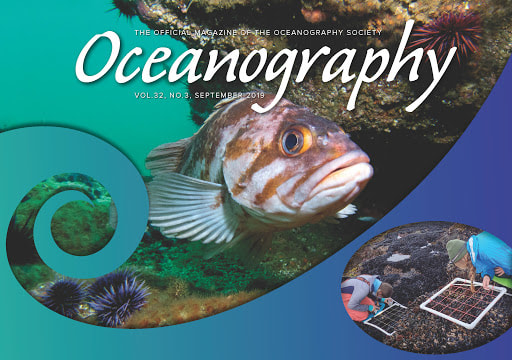
- Chan, F., et al. 2019. The dynamics and impact of ocean acidification and hypoxia. Oceanography 32 (3): 62-71 https://doi.org/10.5670/oceanog.2019.312
- Menge, B.A., et al. 2019. PISCO: Advances Made Through the Formation of a Large-Scale, Long-Term Consortium for Integrated Understanding of Coastal Ecosystem dynamics. Oceanography: 32(3):16-25, https://doi.org/10.5670/oceanog.2019.307 - Lubchenco, J. et al. 2019. Connecting PISCO Science to Policy Makers, Managers, and Citizens. Oceanography: 32(3):106–115, https://doi.org/10.5670/oceanog.2019.317 |
|
- Grorud-Colvert, K. et al. 2019. High-profile international commitments for ocean protection: Empty promises or meaningful progress? Marine Policy 105:52-66. https://doi.org/10.1016/j.marpol.2019.04.003
- Roberts, C., et al. 2017. Marine reserves can mitigate and promote adaptation to climate change. Proceedings of the National Academy of Sciences 114 (24): 6167-6175 https://doi.org/10.1073/pnas.1701262114
- Roberts, C., et al. 2017. Marine reserves can mitigate and promote adaptation to climate change. Proceedings of the National Academy of Sciences 114 (24): 6167-6175 https://doi.org/10.1073/pnas.1701262114
|
Recent Book Chapters
- Lubchenco, J. 2019. People and the Ocean 3.0: A New Narrative with Transformative Benefits. pp 72-84 In Daniel C. Esty, ed: A Better Planet: 40 Big Ideas for a Sustainable Planet. (Yale University Press, New Haven, Connecticut). - Sullivan, J.M., V. Constant, J. Lubchenco. 2019. Extinction threats to life in the ocean and opportunities for their amelioration. pp 113-137 In P. Dasgupta, P. H. Raven, A. L. McIvor, eds: Biological Extinction: New Perspectives. Cambridge, UK: Cambridge University Press, ISBN 978-1-108-48228-8. - Mattison, C. and J. Lubchenco. 2019. Clay, Coral, and Climate Change: Conserving the Seas through Ceramic Art. Pp 40-49 In J. S. Parsons, ed., Catalogue for Fragile Earth: The Naturalist Impulse in Contemporary Art, Florence Griswold Museum, Old Lyme, CT; 120 pp. |
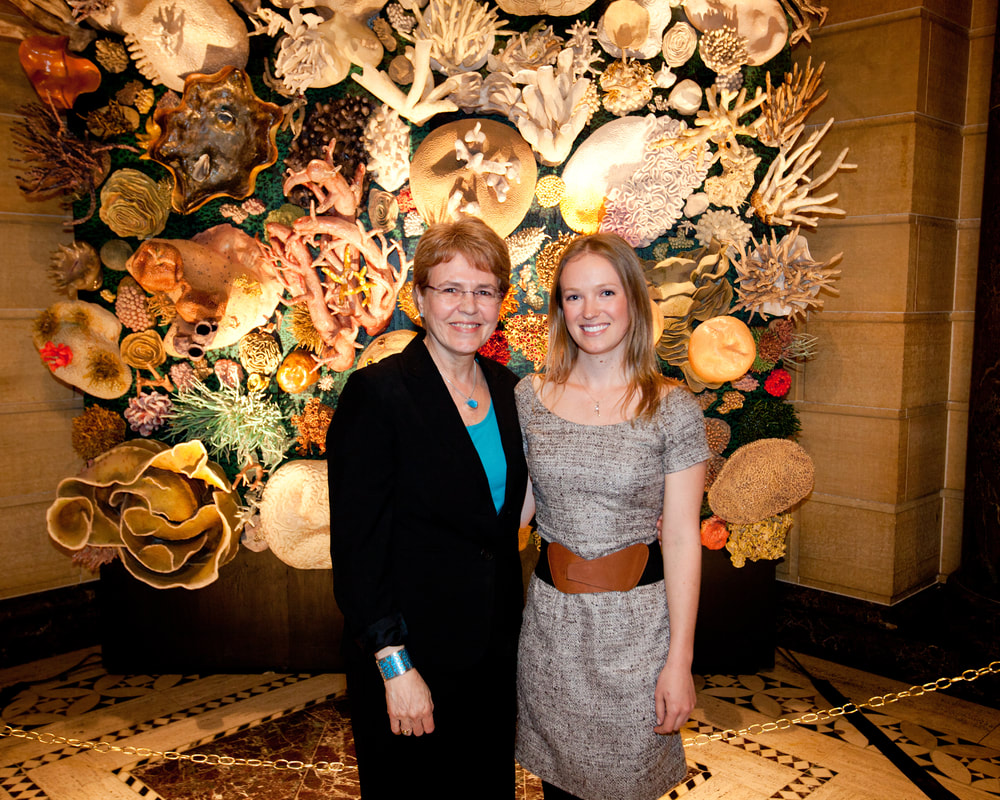
Jane Lubchenco and Courtney Mattison in Washington D.C., 2012
|